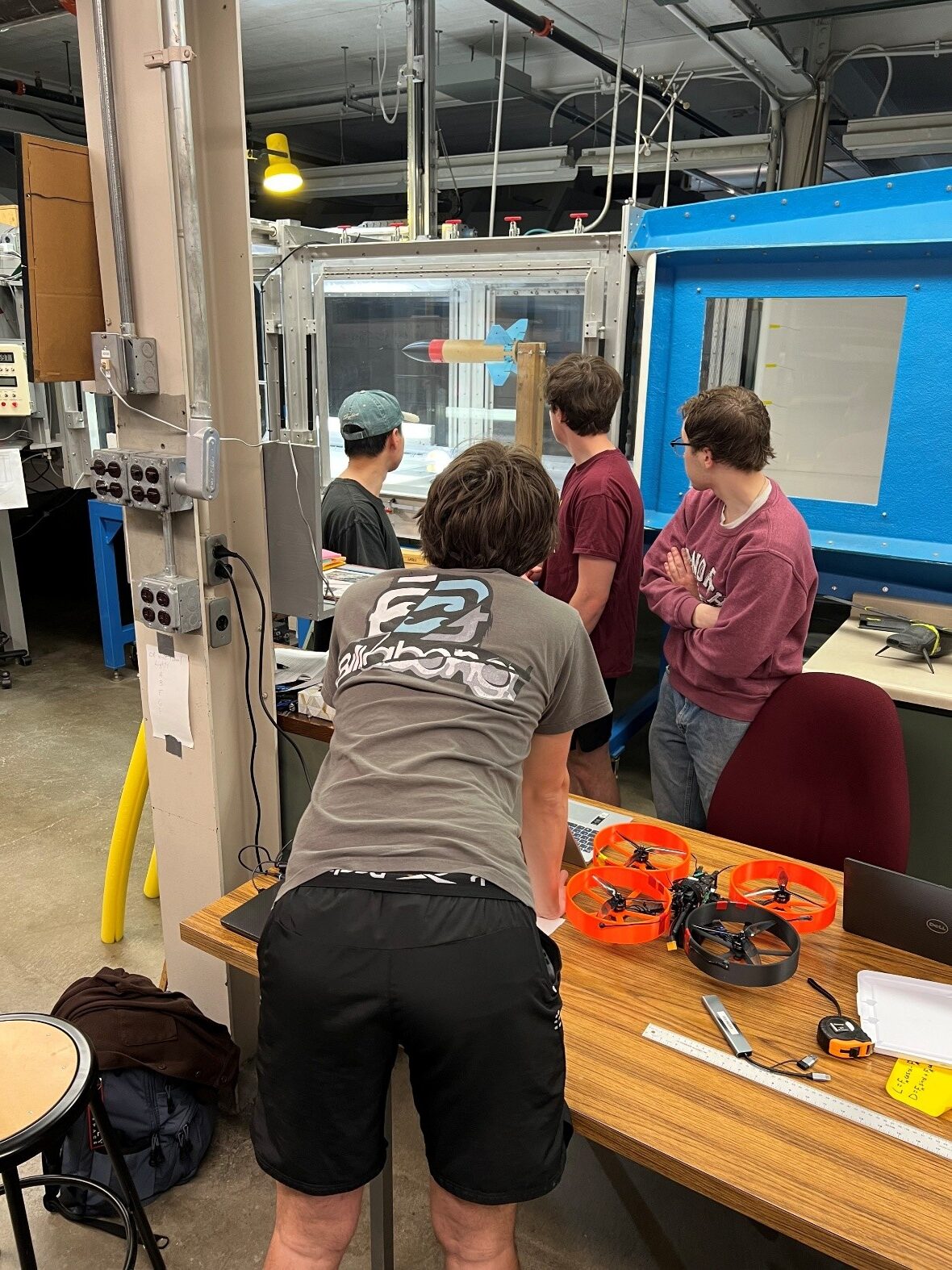
The Minnesota Space Grant hosted the (nationwide) Space Grant Midwest High-Power Rocketry COMPETITION and, in parallel, the MN Space Grant Intercollegiate High-Power Rocketry CHALLENGE on the weekend of May 16-17, 2026.
Saturday, May 16 (oral presentations and safety checks):
The first day ran from 5 p.m. till about 9 p.m. in Akerman Hall at the University of Minnesota (110 SE Union St, Minneapolis), with safety checks and competition team oral presentations to judges
Sunday, May 17 (launches – weather permitted, barely! – the back-up launch date was Monday, May 18):
The event’s second day ran from 9 a.m. till 4 p.m. with a rocket fly-off at the Tripoli Minnesota high-power rocketry club launch site just outside of North Branch.
Spectators were welcome to all events.
The MN Space Grant Intercollegiate High-Power Rocketry Challenge (for newer, less-experienced teams) involved Century (Community) College, Anoka-Ramsey Community College, Fond du Lac Tribal and Community College, and St. Johns University / College of St. Benedict. Three other teams (Minnesota State Moorhead, Gustavus Adolphus College, and University of Minnesota Morris) participated in the fall 2025 challenge activities, but not all of the spring 2026 activities.
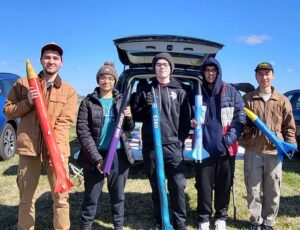
The Space Grant Midwest High-Power Rocketry Competition involved teams from the University of Minnesota Twin Cities (3 teams), Macalester College, Bethel University, Augsburg University, and Normandale Community College, as well as teams from Iowa, Wisconsin, Michigan, Maryland, Ohio, Louisiana, Tennessee, and one team from overseas.
And the winners are…
Peer awards: “Best Rocket Build” to Louisiana State University (LSU); “Best Instrumentation” to U of MN Twin Cities Rocket Team; “Coolest-Looking Rocket” also to LSU – congratulations all!
Judged awards: 1st place to U of MN Twin Cities Rocket Team (in Minneapolis); 2nd place to Bethel University (in St. Paul); 3rd place to Cedarville University (in Ohio) – congratulations all!
Competition Task:
The “Secret-Message Challenge”
Summary Description (Historical)
Student teams will design and construct a single-motor, single-stage, high-power rocket and fly twice during the competition on an AeroTech H195NT-14A DMS motor and on a Cesaroni 382I170-14A motor. Note: These motors have different diameters.
This year the challenges are:
(A) Have the rocket carry a down-facing camera system to collect in-flight video watching a set of up-facing bright lights spread out near the launch pads that are flashing a repeating coded message (about 10 seconds long, with new patterns displayed approximately every half-second) and keep the set of lights in view and be able to distinguish the patterns for as long as possible, during both ascent and descent.
(B) Implement a roll-control mechanism, with indicator lights in view of the down-facing camera system, showing what the mechanism is trying to do. Demonstrate the ability to control the roll of the rocket on ascent (at least roll CW 90°, then roll CCW 90°). Note: Teams can try to use the roll control capability to keep the set of lights in view.
(C) Have the rocket carry a “non-commercial” (i.e., not sold for rocketry) data-logging sensor suite and use it to log at least once a second (even faster would be better) GPS (latitude, longitude, and altitude), ambient pressure, 3-axis acceleration, 3-axis roll, and status of the roll control mechanism during the entire flight.
Bonus points will be given to:
(1) Teams whose member(s) increase their certification level(s) using individually-built rockets (in parallel with the (team-built) competition rocket).
(2) Teams that implement a telemetry system with which they can transmit information about the pattern of lights (i.e., evidence that they “got the message,” even if they cannot decode it (yet)) to a ground station located near the LCO table within 10 minutes of landing and before going out to recover the rocket.
(3) Teams that are able to decode the message (more bonus points given to teams that decode the message more quickly).
All fabrication work on the rocket(s), except for possibly machining of plastic and/or metal parts, must be performed by students.
2025-2026 Midwest Competition website