Competition Announcement: Unique NASA Opportunity to Design, Build, and Launch High-Power Rockets
The Minnesota Space Grant Consortium (MnSGC: www.mnspacegrant.org), working with the Tripoli, Minnesota, High-Power Rocketry Club (www.tripolimn.org), hereby announces the 2026-2027 Space Grant Midwest High-Power Rocketry Competition. The fly-off will be held in Minnesota, but this competition is open to college and university student teams from across the nation during the 2026-2027 academic year. This competition is an opportunity for students to design and construct high-power rockets, to be launched in May 2027 from a Tripoli high-power rocket club launch site just north of Minneapolis.
No previous experience in high-power rocketry is necessary to compete!
Up to 16 college and university teams, sponsored by their states’ Space Grants, will be accepted into this competition. Interested teams from any state, not just those in the Space Grant Great (Lakes) Midwest Region, are required to garner local Space Grant “sponsorship” (this might or might not involve financial support, depending on the state) and submit a non-binding “Notice of Intent to Compete” to the MnSGC by Sept. 30, 2026, in which they list the team’s student members and students’ certification level(s) (if any), team name, and a committed faculty adviser. (Note – institutions not planning to start until spring 2027 still should still submit a Notice of Intent to Compete by Sept. 30, 2026, naming a faculty adviser (so that we know who to send updates to.)) Teams are also required to consult with a non-student mentor who has high-power rocketry experience and is Level 2 certified (or higher). Competition organizers can help teams recruit a certified high-power rocketry mentor, upon request.
A kick-off/informational videocon will be held from 7 to 8 p.m. Central Time on Thursday, Sept. 10, 2026, for teams planning to spend the full academic year on this project. This kick-off/informational videocon will be repeated (upon request) on Thursday, Jan. 7, 2027, for teams working just during the winter/spring term(s). A registration fee of $450 per team, due by Oct. 31, 2026, will be charged to cover competition costs, of which $100 will be applied toward the purchase of 3 motors needed for the in-person competition fly-off. Note: Motor(s) for test flights and cert. flights need to be explicitly specified in the Notice of Intent to Compete and paid for with the registration. States sponsoring two or three teams will be expected to provide one judge for written and oral reports and the (in-person) competition fly-off. States fielding four or more teams may be asked to provide two judges.
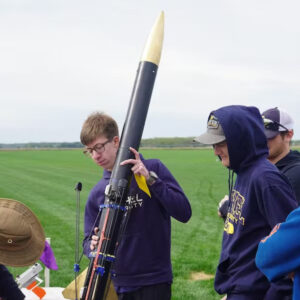
The 2026-2027 Space Grant Midwest High-Power Rocket “Strap-on Booster” Challenge (summary description):
In this competition, college/university student teams will design and construct a three-motor (one core motor and two (identical) booster motors), air-start, high-power rocket to fly once during the competition. This year the challenges are:
(A) Launch the rocket on the two booster motors and air-start the core after booster burn-out (but before too much slowing) OR launch the rocket on the core motor and air-start the two boosters (at the same time!) after core burn-out (but before too much slowing). All air-starts must be controlled by avionics located in the core of the rocket.
(B) Have all spent booster(s) separate from the core after they burn out but no later than apogee (recommendation: use their motor eject to deploy their parachute). Have the core and all spent booster(s) return to the ground separately and land safely, each under its own parachute (no streamers). If the rocket is launched using the core motor, the design must fly safely even if one (or both) of the boosters fail to air-start (note: any booster that does not air-start must not detach from the core, so the core will need a parachute sized to potentially deal with unspent booster(s) still attached). If the rocket is launched using the boosters, the design must fly safely if only one booster ignites and also fly safely if the core fails to air-start (in which case the core motor eject will fail to go off, so this approach requires redundant electronic eject at apogee).
(C) Have the rocket core carry a “non-commercial” (i.e. not sold for rocketry) data-logging sensor suite and use it to log at least ten times a second (even faster would be better) ambient pressure, 3-axis acceleration, 3-axis roll, and temperature near each of the three nozzles (as secondary evidence of which motors fired when).
The two booster motors will be 29 mm diameter AeroTech H169WS-13A DMS single-use motors (no case required). The core motor will be a 38 mm diameter AeroTech H283ST-15A DMS single-use motor (no case required).
Bonus points will be given to (1) teams whose member(s) increase their certification level(s) using individually-built rockets (in parallel with the team-built competition rocket), (2) teams that collect on-board video showing the motors burning and also booster separation, filmed from the core of the rocket or from at least one of the boosters, and (3) teams that log basic performance of both boosters: at least max. acceleration, max. velocity, max. altitude, and landing speed (note: the non-commercial core sensor suite will log much more performance data about the core than that).
Additional details about the competition will be included in a handbook, including due dates and report content/ page limits. Note: All fabrication work on the rocket(s), except for possibly machining of plastic and/or metal parts, must be performed by students.
The competition will include two written reports about the design, analysis, simulation, build, and test flight results of the competition rocket, an oral presentation, plus a written assessment of competition flight data/results. These will be scored by a panel of professional engineers from both academia and industry. Scoring of the pre-fly-off reports and the post-flight reports will focus on rocket design and performance. More details about the competition rules, reports, deadlines, etc. will be described in a competition handbook and discussed during the informational videocon. A competition handbook, including a more-extensive description of the challenge rules, will be posted by 9/10/26 at
http://dept.aem.umn.edu/mnsgc/Space_Grant_Midwest_Rocketry_Competition_2026_2027/
Logistical questions may be directed to James Flaten, MN Space Grant and U of MN – Twin Cities, flate001@umn.edu.
Technical questions may be directed to Gary Stroick, Tripoli MN High-Power Rocketry Club. gstroick@comcast.net.
Important Dates
- Kick-off/informational videocon: Thursday, Sept. 10, 2026 (repeated, upon request, Thurs. Jan. 7, 2027) from 7 to 8 p.m. Central Time (contact James Flaten, flate001@umn.edu, for call-in information)
- Submit a (Non-binding) “Notice of Intent to Compete” and explicit motor list by Sept. 30, 2026 (this deadline applies all schools, even those with teams not forming till later in the school year)
- A non-refundable $450 Team Registration Fee is due by Oct. 31, 2026, $100 of which will be used to help fund the 3 competition-day motors – pay for all motors to be burned in MN by this date as well.
- We will announce “Plan A” or “Plan B” or “Plan C” (described below) no later than mid-day Friday, 5/15/27. Make travel plans to be in town by Friday evening and leave on Monday (not too early), in case we need to fly on Saturday morning (“Plan B”) or delay flying till Monday morning (“Plan C”).
- Competition Timing “Plan A” (weather looks OK for Sunday flights): Presentations & Safety Checks Saturday, 5/15/27* (starting at noon); flights on Sunday, 5/16/27* (all day, then evening banquet)
- Competition Timing “Plan B” (weather not OK to fly on Sunday, but OK to fly on Saturday): Safety Checks & Flights Saturday, 5/15/27* (starting at 9 a.m.); Presentations on Sunday, 5/16/27* (starting at noon, then evening banquet)
- Competition Timing “Plan C” (weather prevents flying both Saturday and Sunday): Presentations & Safety Checks Saturday, 5/15/27* (starting at noon); “day off” on Sunday, 5/16/27* (then evening banquet); Flights Monday, 5/17/27* (starting at 9 a.m. (or as early as weather allows) and going as long as needed)
* If Minnesota has a particularly-wet spring and the launch site clearly will not be useable by mid-May, the competition dates might need to shift. This will be announced as far in advance as is practical.